Thanks for reading the CLEVERPREP blog. This is a short post about SQE2.
Updated to incorporate the July 2025 SQE2 statistical report, published 19 November 2025.
If you are preparing for SQE2, you will know that on the written portion, each day has four skills assessments: one each of Case and Matter Analysis, Legal Writing, Legal Research, and Legal Drafting. Day 1 tests the subjects of Dispute Resolution and Criminal Litigation. Day 2 tests the subjects of Property Practice and Probate (Wills and Trusts). Day 3 is all Business Law and Practice and is therefore not relevant to this post.
On each of the first two days, two of the skills assessments will be on one subject and the other two will be on the other. However, which subject will be tested with each specific skill is unknown. Or is it?
CLEVERPREP has analysed the SRA’s statistical reports for the twelve sittings of SQE2 and we have found a pattern. Of the 96 day 1 and day 2 assessments across the twelve sittings, all but six simply alternated the skill/subject pairing from the previous exam:
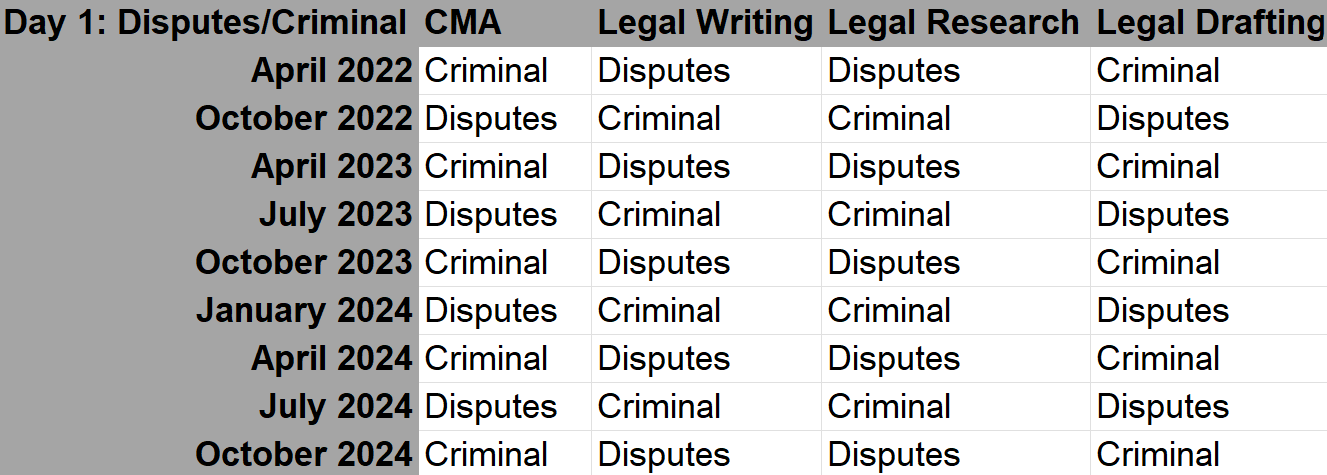
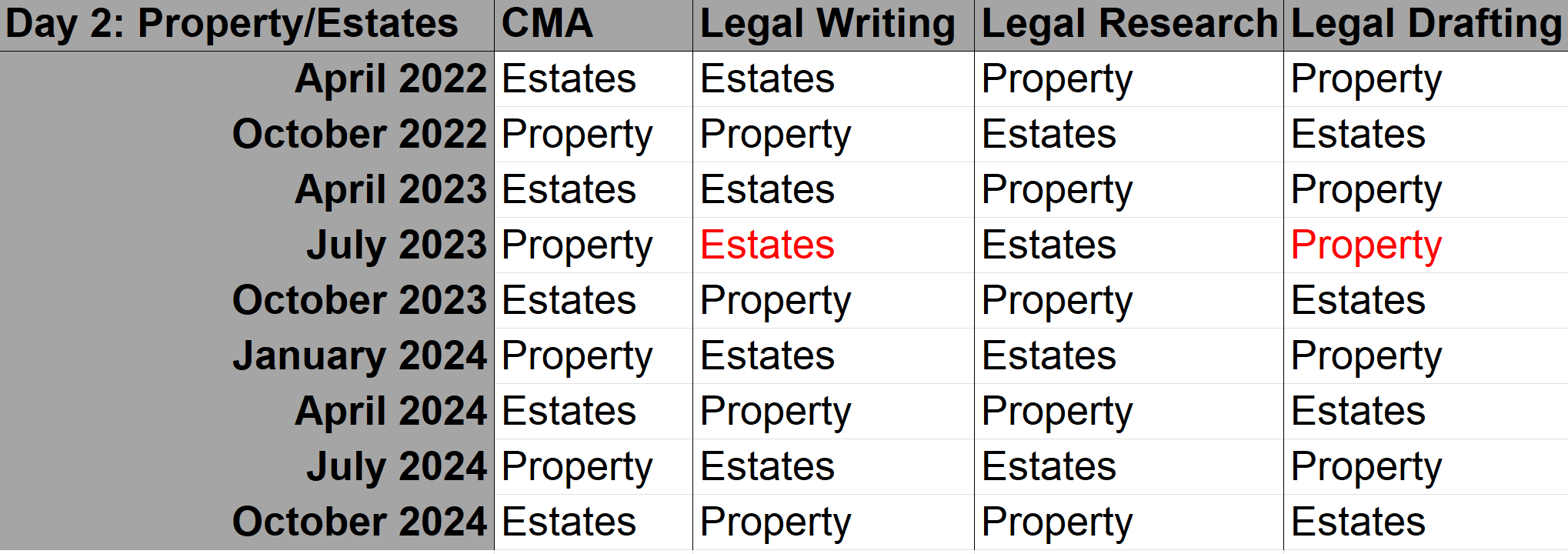
As you can see, all of the deviations occurred on day 2 (Property/Estates). Day 1 has perfectly alternated across the twelve sittings of SQE2.
What does this mean for candidates? It does not mean that a particular skill/subject pairing is guaranteed on your particular exam. As such, you should prepare for all subjects and all skills, and where relevant e.g. drafting, study for all types of documents in scope. However, given that this pattern has played out on 70 of 72 occasions (97% of the time), it does provide an avenue to gamify your preparation for the exam. The ability to use these statistics to assign a higher probability of one skill/subject pairing over another is most relevant to drafting. If, for example, you have a sufficient understanding of both disputes and criminal drafting, but the pattern suggests the drafting exercise on your exam will be disputes, you may wish to use your final revision time to prioritise the documents you might have to draft in a disputes context, especially the more niche ones. That way, if you are wrong, you still had a sufficient knowledge of criminal drafting, but if right, you likely score a 5 where you would have gotten a 4, or a 4 where you would have gotten a 3, due to the extra time spent focusing on the probabilistic scenario.
With that being said, the best approach is to prepare for all subjects and all skills, and that begins with a superior grasp of the legal content such that you can best demonstrate your skills against the assessment criteria. The approach in this post is an advanced strategy, and if used, should be done responsibly (from a position of being well prepared generally) and with the understanding that a probabilistic favourite is not a guarantee.
If you choose to use the pattern, remember the results of the previous sitting are not released by the time of the next sitting. Therefore, you must assume the pattern held on the previous sitting and the pairing will be the same as the last available pairings. For example, if you are studying for the January 2026 SQE, you must assume the pattern held during the October 2025 exams and choose the same pairings as July 2025.
______________________
As for improving those scores, CLEVERPREP’s engaging flashcards and guided tuition will enable candidates to raise their 3s to 4s and their 4s to 5s, helping them to take advantage of the statistical reality of SQE2.
Additional resources:
1. Read about the CLEVERPREP method to easily learn the law required to pass SQE1 or SQE2.
2. Click here to view the full syllabus of legal rules available to study in our SQE flashcards, and a link to access a preview of 10 cards per subject. Each subject is currently £29.99, but you can access all 16 subjects on SQE1 for £279.99 or all 13 subjects on SQE2 + advocacy legal content and skills for £229.99.
3. Access and study a preview of 10 flashcards per subject here.
4. Read another of our blog posts on SQE2, discussing the fact you don’t need to pass all SQE2 assessments to pass SQE2 overall (in fact you can score quite poorly in a majority of assessments, and still pass).